|
|
|
|
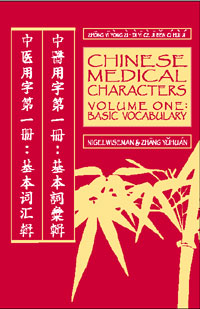
| Chinese Medical Characters: Basic Vocabulary |
|
|
By Nigel Wiseman & Zhang YuHuan |
|
Learning Chinese is very probably the most rewarding single investment
that a student of East Asian medicine can make. A knowledge of Chinese
provides access to the knowledge and experience of East Asian physicians
over a period of two thousand years. By learning Chinese, one gains
entry into a library of information a thousand times larger than
any that exists in English or any other Western language. One gains
the ability to communicate with Chinese physicians in their own
language and to share their knowledge and experience. Ultimately,
one gains the ability to think in the language that has been used
by generations of Chinese doctors and scholars to record their experiences
and considerations about traditional Chinese medicine.
The current text presents the first 100 characters based upon frequency
of use in medical texts, as well as an overall program designed
to help the student acquire the necessary tools for building a thorough
vocabulary. This first volume (in a series of five) presents the
basics of Chinese characters along with the etymologies of the 100
most commonly seen characters. Designed as a workbook, it offers
students practice in learning to read, recognize, and write the
characters and provides the basic tools that students need to become
familiar with the written language of Chinese medicine and thereby
enrich their studies.This book is more than just a fine collection
of practical instruction.
|
|
The introduction provides context through a very
accessible tour of modern Japanese training and
practice that includes a highly useful guide to root
treatment. Each of the techniques is also made
more valuable by suggested treatment protocols for
clinical application.
Publication Date: December, 1994
Paperback; 350 pages; 7 x 10; $40.00
Appendices; Index; Illustrations
ISBN 0-912111-42-9
Order from our distributor
Redwing Book Company
44 Linden St. Brookline MA 02445
Toll Free: 800 873 3946
Canada: 888 873 3947
Other: 617 738 1235
Fax: 738-4620
P.O. Box 1037
202 Bendix Drive
Taos, New Mexico 87571
505 758 7758
|
|